Back pain from sitting at work: 5 habits
Small changes in your day-to-day to look after your back when you spend long hours sitting at the computer, and when to see a physiotherapist.
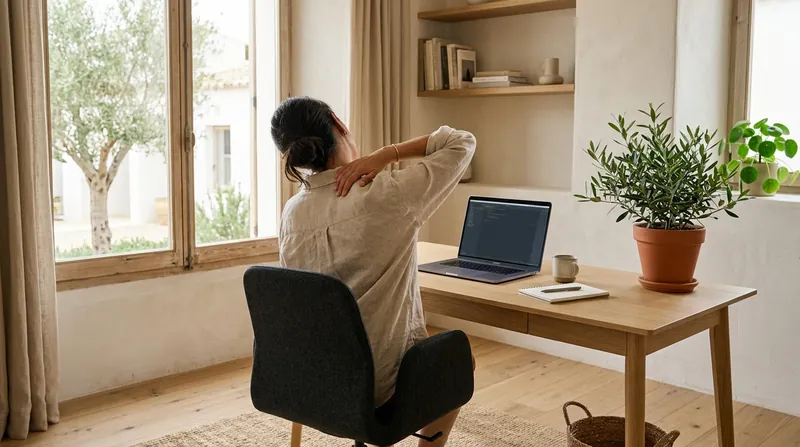
Spending many hours sitting down is one of the most common reasons people ask us about back or neck discomfort. Some good news to start with: research shows that there is no perfect posture and that the way you sit, on its own, doesn't predict back pain. What does help is moving, changing position and staying active.
1. Take breaks and change position
The best posture is the next one: changing position matters more than finding the «right» one. Get up, walk a few steps or stretch gently. If time slips away without you noticing, set an alarm.
As a guide, Spain's National Institute for Safety and Health at Work (INSST) recommends, for screen work, short, frequent breaks rather than long, infrequent ones: roughly 10–15 minutes for every 90 minutes of screen time, or 10 minutes every hour if the task requires a lot of concentration. Between breaks, any change of position also helps.
2. Adjust your workstation so you're comfortable
A well-adjusted workstation doesn't guarantee your back won't hurt (it hasn't been shown that ergonomic changes, on their own, prevent it), but it does let you work more comfortably and change position easily. According to INSST recommendations:
- Screen: the first line of text at eye level or slightly below, never above, and about 40 cm away or more.
- Feet: flat on the floor; if the chair is too high and you can't reach, use a footrest.
- Chair: height-adjustable, with a backrest that supports your lower back.
- Arms: resting your forearms or using armrests reduces the load on your neck and shoulders.
3. Stay active outside work too
If your back hurts, it's generally better to carry on with your usual activities than to rest in bed. This is what the British NICE guideline on low back pain and the UK National Health Service (NHS) say. Walking, swimming, yoga or Pilates can help; start gently and stop if the pain clearly gets worse.
And even if it doesn't hurt: if you spend the day sitting down, all the moving you do outside work counts. Our article on how to start training includes the WHO's physical activity recommendations.
4. Exercise regularly, including strength training
Exercise is the best-supported measure for preventing new episodes of low back pain. A systematic review published in JAMA Internal Medicine found that exercise, especially combined with education about the back, reduces the risk of a new episode. By contrast, back belts, insoles or information on its own showed no such effect.
There's no need to obsess over your «core»: it hasn't been shown that a weak midsection causes back pain, and some people with pain tend to tense it too much. What's recommended is varied exercise that you enjoy and can keep up, with strength work for the whole body. If you find it hard to get started or are afraid to move, a physiotherapist can adapt the plan for you.
5. Don't normalise pain, and know when to get help
Most back pain improves within a few weeks, but you should have a professional assess you if:
- It doesn't improve after a few weeks of home care or it stops you going about your daily life.
- It isn't relieved by rest, or it gets worse at night or when you cough or sneeze.
- You've lost weight for no reason, you notice a lump or swelling, or the pain is in your upper back, between your shoulder blades.
- You're worried about it or finding it hard to cope with.
Go to A&E or call 112 if your back pain comes with tingling, weakness or loss of feeling in both legs; loss of feeling in the genital or anal area; difficulty urinating or loss of bladder or bowel control; chest pain; or if it started after an accident or a bad fall. If you have a fever or feel generally unwell, book an appointment with your doctor as soon as possible.
At Tana we assess your case in the physiotherapy session and suggest exercises tailored to you. Clinical guidelines recommend that manual therapy, if used, should always be combined with exercise.
Sources
- Back pain — NHS (UK National Health Service)
- Low back pain and sciatica in over 16s: assessment and management (NG59), recommendations — NICE
- Work with display screens (frequently asked technical questions) — INSST
- NTP 602: Ergonomic design of workstations with display screens: the work equipment — INSST
- Prevention of Low Back Pain: A Systematic Review and Meta-analysis (Steffens et al., JAMA Intern Med 2016) — PubMed
- Back to basics: 10 facts every person should know about back pain (O’Sullivan et al., Br J Sports Med 2020) — PubMed
General information for educational purposes. It does not replace an assessment by a professional: if you have questions about your case, ask us.